Updated 2026-08-18 · 902 Drywall Ltd.
The short answer
Across Nova Scotia, drywall supplied, installed and finished to a standard Level 4 typically lands between $2.25 and $3.25 per square foot of board — that is wall and ceiling area, not floor area. Hanging alone, with no taping, usually runs $0.90 to $1.50. Finishing alone, on board somebody else hung, usually runs $1.10 to $1.90.
Those are market ranges, not a quote. A quote depends on the drawings, the access, the ceiling heights and the finish level specified. We price every job from the actual scope.
| Scope | Typical Nova Scotia range |
|---|---|
| Board supplied, installed and finished (Level 4) | $2.25 – $3.25 / sq ft |
| Hang only, no finishing | $0.90 – $1.50 / sq ft |
| Tape and finish only | $1.10 – $1.90 / sq ft |
| Level 5 skim coat upgrade | add $0.60 – $1.10 / sq ft |
| Insulation and vapour barrier | $1.10 – $2.00 / sq ft |
| Small repair or patch visit | $250 – $600 |
Square feet of board, not square feet of floor
This is where most confusion starts. A 1,000 square foot basement does not contain 1,000 square feet of drywall — it contains the walls plus the ceiling, which is usually somewhere between 2.5 and 3.5 times the floor area once you account for partitions.
So a 1,000 square foot basement is realistically 2,800 to 3,400 square feet of board. At $2.50 per square foot that is roughly $7,000 to $8,500 supplied and finished. If a quote looks dramatically cheaper than that, check which number the contractor is pricing against before you celebrate.
What actually moves the price
Two jobs of identical square footage can differ by 40 percent. These are the factors that do it, roughly in order of impact.
- Finish level. A Level 5 skim coat is a whole extra operation over the entire surface, not just the joints. It is the single biggest line-item swing on most jobs.
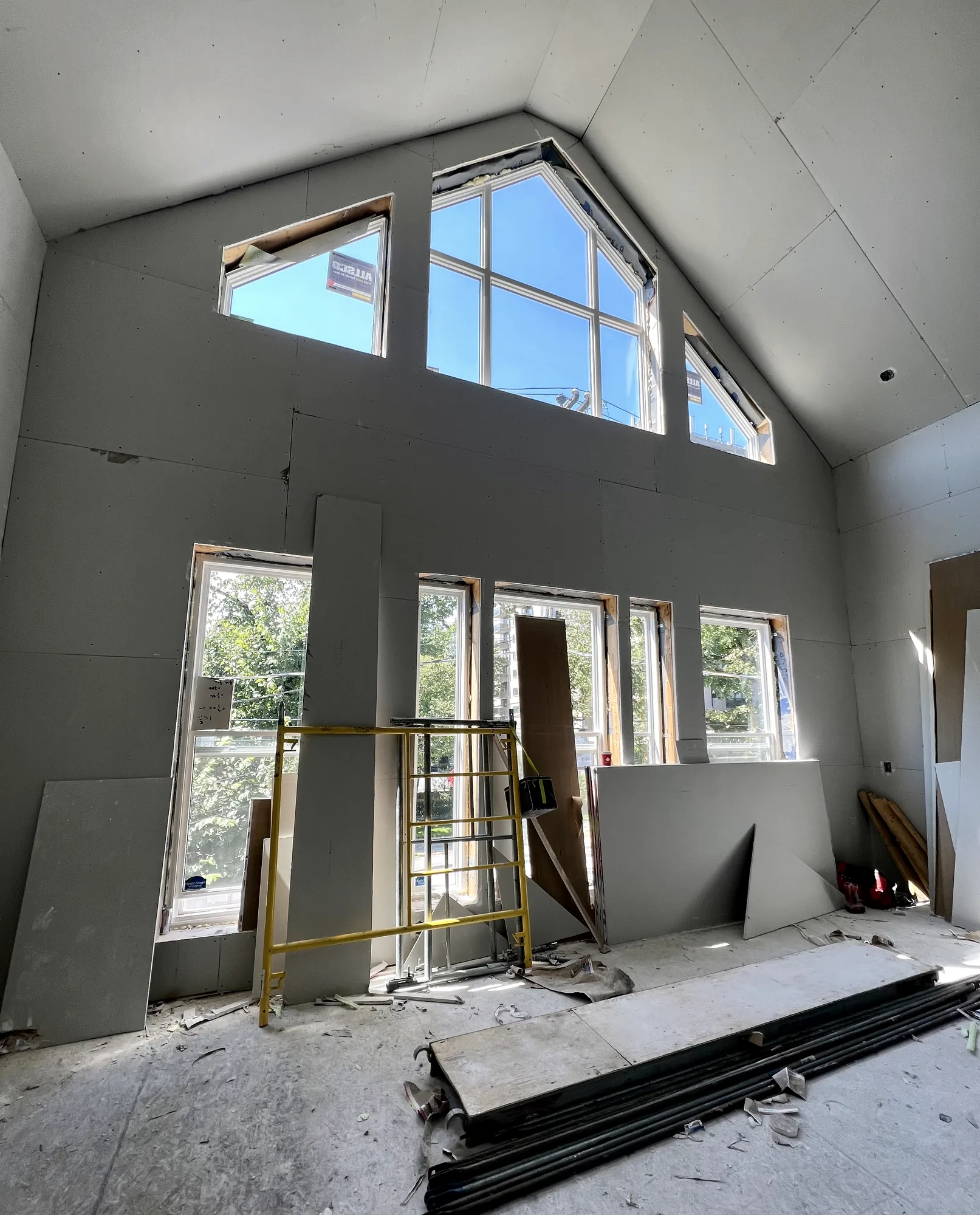
- Ceiling height. Anything above a standard eight-foot ceiling means staging, stilts or lifts, and slower work. Cathedral and double-height rooms carry a real premium.
- Access and stocking. Board has to physically get to the floor it is going on. A walk-in basement is cheap to stock. A fourth-floor walk-up, or a site with a shared hoist and a booking window, is not.
- Board type. Standard board is the baseline. Moisture-resistant, mould-resistant, abuse-resistant, Type X and soundproofing board all cost more per sheet and sometimes more to hang.
- Occupied versus empty. Working around a family, tenants or a trading business means dust control, protection and shorter working windows.
- Repair versus new. Patching is slower per square foot than open new work, because most of the time goes into cutting back, matching and blending rather than covering ground.
Residential versus commercial
Commercial and multi-residential work usually prices lower per square foot than a one-room residential job, because the crew can run uninterrupted across a full floorplate and stocking is done in bulk. The trade-off is that commercial jobs carry schedule obligations, rated assembly requirements and documentation that residential work does not.
A single room in an occupied house is the most expensive drywall you can buy per square foot. That is not a markup — it is genuinely the least efficient way to do the work.
How to compare two drywall quotes properly
If one number is much lower than the other, it is almost never because one contractor is cheaper. It is usually because they are quoting less work. Check these six things before you decide.
- Is the finish level stated? If a quote does not say Level 4 or Level 5, you do not know what you are buying.
- Is board supply included, or is it labour only?
- Does it include insulation and vapour barrier, or is that a separate trade?
- Who is doing the sanding and dust control, and who cleans up?
- Is corner bead, backing and blocking included?
- Is there a deficiency period after handover, and what does it cover?
A quote that is a single number with no scope attached is not a quote, it is a guess. Ask for it line by line — every honest contractor can produce one.
What we do
Send us the architectural drawings and the specification and we complete a full quantity takeoff, then price board, insulation, ceilings and finishing as separate line items. You get a breakdown you can compare against every other bid you have, and we flag anything in the drawings that will not build as drawn before it becomes a change order.